The PLONK IOP for general circuits
PLONK: a poly-IOP for a general circuit
Step 1: compile circuit to a computation trace (gate fan-in=2)

The computation trace (arithmetization):
| left inputs: | right inputs: | w | |
|---|---|---|---|
| inputs: | 5 | 6 | 1 |
| Gate 0: | 5 | 6 | 11 |
| Gate 1: | 6 | 1 | 7 |
| Gate 2: | 11 | 7 | 77 |
Encoding the trace as a polynomial
Notion:
,
let (in example, ) and
The plan:
prover interpolates a polynomial that encodes the entire trace.
Prover interpolates such that
(1) encodes all inputs: for
(2) encodes all wires: :
- left input to gate #
- right input to gate #
- output of gate #
In the example, Prover interpolates such that:
| inputs: | |||
|---|---|---|---|
| Gate 0: | |||
| Gate 1: | |||
| Gate 2: |
degree() = 11
Prover can use IFFT to compute coefficients of in time
Step 2: proving validity of
Prover needs to prove that is a correct computation trace:
(1) encodes the correct inputs,
(2) every gate is evaluated correctly,
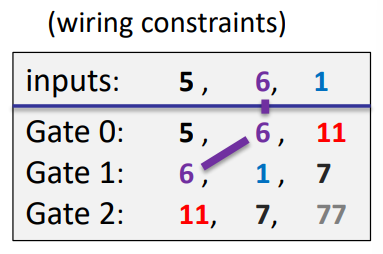
(3) the wiring is implemented correctly,
(4) the output of last gate is 0
Proving (4) is easy: prove
Proving (1): T encodes the correct inputs
Both prover and verifier interpolate a polynomial that encodes the -inputs to the circuit:
In the example: ( is linear)
constructing takes time proportional to the size of input verifier has time do this.
Let (points encoding the input)
Prover proves (1) by using a ZeroTest on to prove that
Lemma: is zero on if and only if is divisible by
Proving (2): every gate is evaluated correctly
Idea: encode gate types using a polynomial
define such that :
- if gate #l is an addition gate
- if gate #l is a multiplication gate
| inputs: | 5 | 6 | 1 | S(x) |
|---|---|---|---|---|
| Gate 0: | 5 | 6 | 11 | 1(+) |
| Gate 1: | 6 | 1 | 7 | 1(+) |
| Gate 2: | 11 | 7 | 77 | 0(\times) |
Then :
Prover uses ZeroTest to prove that for all :
Proving (3): the wiring is correct
encode the wires of :
Define a polynomial that implements a rotation:
Lemma: wire constraints are satisfied
The complete Plonk Poly-IOP (and SNARK)
Prover proves:
gates: (1)
inputs: (2)
wires: (3)
output: (4)